
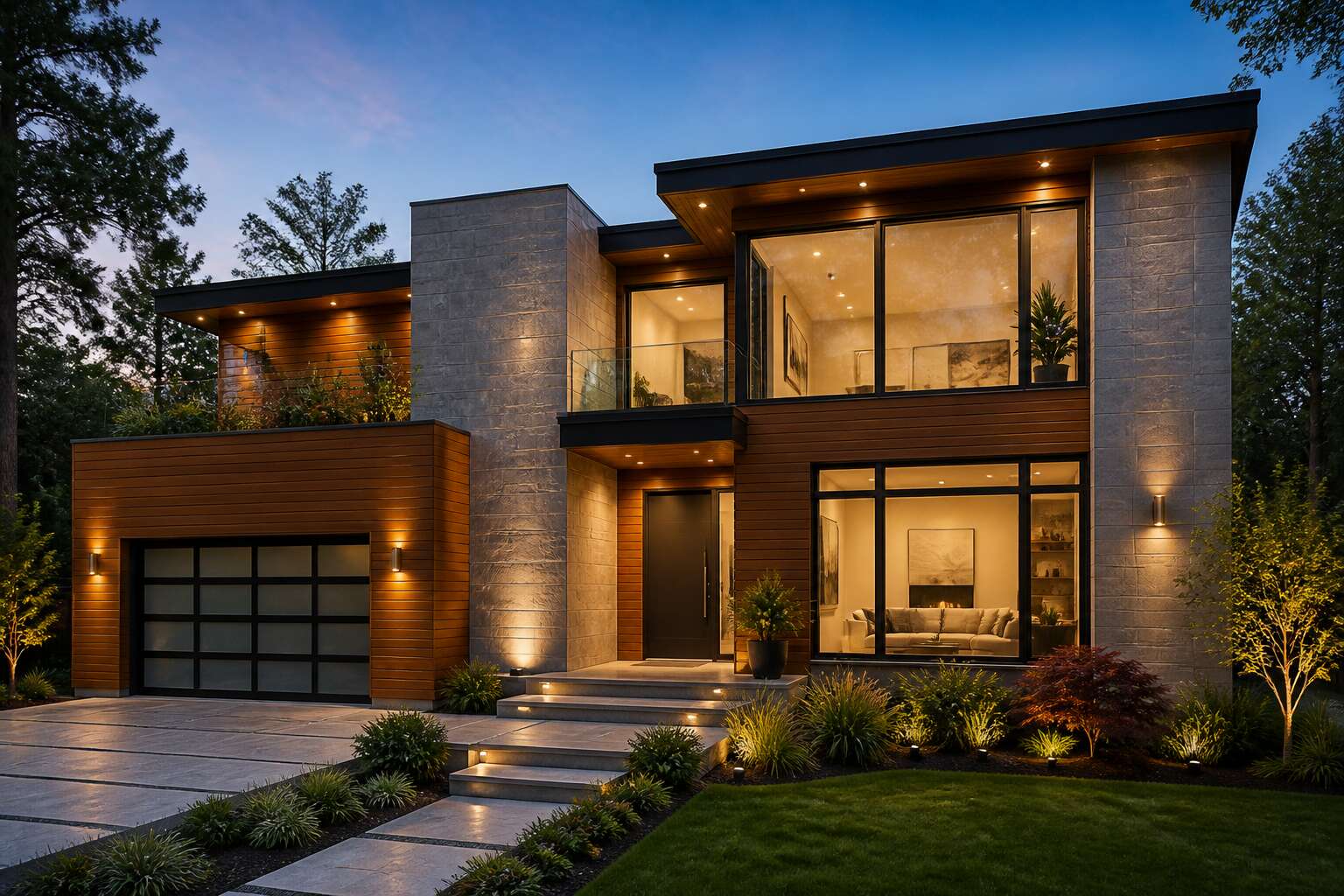
Material Options for Exterior Wall Cladding
Natural Stone Veneer and Its Timeless Appeal
Stone is the oldest building material on Earth, and it still outperforms most modern options. Natural stone veneer brings permanence to a facade without the structural load of full masonry. The surface catches light differently at every hour, changing the character of the wall. When exploring wall cladding exterior ideas, this material remains the benchmark for durability. It will not fade, rot, or peel. It simply weathers.
The choices are broader than most expect:
- Slate offers a dark, dramatic cleavage.
- Quartzite brings subtle sparkle and hardness.
- Granite delivers speckled strength.
- Travertine contributes warm, porous texture.
I have yet to see a stone clad wall that looks cheap. A properly fitted veneer turns a plain elevation into a feature built to outlast its neighbours. Among exterior options, stone offers the longest return on investment.
Fiber Cement Panels for Modern Facades
Fiber cement panels contain no timber, yet they outlast almost every timber product on the market. The matrix of Portland cement, sand, and cellulose pulp is autoclaved into a dense mineral board. Termites find nothing to eat. Fire finds nothing to fuel. The South African sun and salty coastal air do not bend it.
The finish arrives factory sealed. A baked-on colour layer holds for decades without repainting. Boards come in clean, sharp dimensions. For modern wall cladding exterior ideas, this delivers the flat, controlled surface architects want.
Here is what separates a quality panel from a poor one:
– Thicker cores resist impacts better
– Pre-sealed edges block moisture entry
– Texture mimics timber or render without the upkeep
The weight feels solid, yet installation needs no heavy machinery.
Wood Cladding Choices: Cedar, Thermowood, and Reclaimed Timber
No two timber facades ever look the same, and that is exactly the point. Cedar brings natural oils that repel insects and moisture. Thermowood, heat treated in a closed chamber, gains stability without chemical preservatives. Reclaimed timber carries old saw marks and bolt holes that tell a building’s story.
When exploring wall cladding exterior ideas, wood cladding choices demand an honest conversation about maintenance. Cedar greys softly unless oiled. Thermowood resists warping under the Highveld sun. Reclaimed boards need inspection for hidden fasteners and rot before they earn a place on your walls.
- Cedar suits coastal homes where salt air tests lesser timbers
- Thermowood fits inland climates with wide temperature swings
- Reclaimed timber gives rural properties a layered, lived-in texture
The right board turns an ordinary wall into something people want to touch.
Metal Cladding: Aluminum, Corten Steel, and Zinc
Metal cladding demands a different kind of attention. Aluminum is lightweight, resistant to corrosion, and takes a powder coat finish with ease. Corten steel forms a protective rust layer that actually prevents further oxidation. Zinc develops a natural patina over time, and it is fully recyclable.
For wall cladding exterior ideas, metal offers a distinct alternative to timber and stone. I have watched corten panels turn a deep umber after a single Highveld storm. Zinc, by contrast, changes slowly, its surface mottling into soft greys and blues.
Consider these metal qualities:
- Aluminum does not warp under extreme heat.
- Corten requires no painting or sealing.
- Zinc is low maintenance but needs proper detailing.
The key is to understand each metal’s behaviour. Metal cladding requires thoughtful installation and patience.
Vinyl and Composite Cladding for Budget-Friendly Projects
Some of the most practical wall cladding exterior ideas do not require a fortune or a specialist contractor. Over the past decade, vinyl and composite systems have grown from cheap alternatives into durable products in their own right. A recent industry report noted that vinyl cladding accounts for nearly a third of all residential re-clads in Gauteng, largely due to its resistance to moisture and termites. It offers a clean, uniform finish that mimics wood grain without the annual maintenance.
For budget conscious homeowners, the financial distinction is significant. Vinyl panels are often 25% cheaper than fiber cement once installation labour is factored in. Composite cladding, which blends wood fibres with recycled plastics, sits slightly higher in price but offers a longer service life.
Here is a quick comparison for planning purposes:
1. Vinyl is the lighter option, making it easier to handle on a two storey façade.
2. Composite boards resist fading better in the Highveld UV conditions.
3. Both systems use a ventilated rain screen approach, which helps regulate temperature.
The real advantage of composite lies in its rigidity. It does not flex or drum under strong coastal winds. Vinyl, however, can be prone to cracking if struck by flying debris during a storm. I have seen both cladding types perform admirably on homes in Durban and Pretoria, but the key is to ensure adequate expansion gaps during installation. Tightly butted joints cause buckling, and water gets trapped behind the panels. These wall cladding exterior ideas are perfect for homeowners who want a refreshed look without the long installation timelines of masonry or stone. The finished surface requires little more than a periodic wash down to keep its colour vibrant.
Design Styles and Architectural Trends
Minimalist and Contemporary Aesthetics
Minimalist architecture has a strange power. It makes the building look inevitable. In South Africa, contemporary facades are shedding ornamentation for clarity, and this approach to wall cladding exterior ideas prioritises proportion over decoration. I have seen this trend gain momentum in Cape Town’s coastal suburbs, where architects specify flush, monolithic surfaces that play with light and shadow. The effect is calm, deliberate, and quietly confident. A well-executed minimalist cladding job can transform a suburban home into a space of quiet retreat. For those exploring this direction, consider these principles:
- Prioritise material texture over colour variation.
- Keep joints and edges minimal and precise.
- Use vertical or horizontal lines to guide the eye.
This trend also embraces negative space, where unclad walls become part of the composition. The result is architecture that feels open and unhurried.
Rustic and Farmhouse-Inspired Exteriors
Rustic and farmhouse exteriors speak to a slower way of building. In South Africa, this style draws from the country’s farmlands. The materials age publicly. Wood grains deepen, and stone holds the morning mist. For wall cladding exterior ideas, this approach favors function over fashion.
Vertical board-and-batten gives the facade a steady rhythm. Rough-sawn planks show every knot and crack. The spaces between boards capture shadows. This honesty builds a psychological comfort. The home feels rooted. Consider the following markers:
- rough textures that invite touch
- earthy tones drawn from the veld
- simple profiles without ornament
- utilitarian details that serve a purpose
These choices do not compete with the surroundings. They submit to them. The result is a quiet authority that only comes from patience.
Industrial Look with Dark Tones and Exposed Fasteners
Industrial cladding shows its structure directly. That is the point. Dark tones absorb light, giving facades the serious expression of a building that has real work to do. Exposed fasteners are not mistakes. They are deliberate details! Torx screws and rivets celebrate assembly over concealment.
- Powder coated steel in charcoal or anthracite
- Concrete boards with visible bolt heads
- Weathered corten with deliberate weld marks
These materials suit wall cladding exterior ideas that refuse to hide their construction. In South Africa’s highveld light, a blackened metal facade reads as both fortress and find. The roughness is intentional. The fasteners do their job, and the shadows complete the composition.
Mixed Material Facades: Combining Wood, Stone, and Metal
Mixed material facades refuse to commit to a single tribe. Stone brings the gravitas of an old bank. Wood offers the warmth of a weekend braai. Metal supplies the quiet confidence of engineering. Together, they respond to South Africa’s highveld light with a composed, layered character.
Consider the interplay. Rough quartzite cladding next to slender cedar planks, then a charcoal aluminium screen. Each material shifts as the sun moves. The stone stays cool. The wood warms. The metal throws sharp shadows across both. I have watched this transformation on a single afternoon in Pretoria.
For wall cladding exterior ideas, the discipline is restraint:
- Limit the palette to three materials
- Let one dominate while two support
- Align joint lines across every surface
Handle this well, and the facade looks intentional. Handle it poorly, and it resembles a building supplies catalogue.
Vertical vs. Horizontal Cladding Patterns
Before colour, before texture, the direction of the boards sets a facade’s character. Vertical runs pull the eye upward, lending height to a narrow double-storey in Johannesburg. Horizontal runs push the facade wide, grounding a sprawling single storey on the Cape flats.
Common patterns across South African projects:
- Vertical timber slats gapped to filter the highveld sun
- Horizontal fibre cement boards fitted tightly for a seamless finish
- Board and batten verticals, standard in Free State farmhouse revivals
Current trends favour vertical orientation at entrances and stairwells. Horizontal patterns hold the street elevation, giving a house a calm, steady presence. I have watched this preference sharpen over the past five years.
When weighing wall cladding exterior ideas, the direction of the boards settles everything else. The texture and the colour adapt to it, not the reverse.
Accent Walls and Feature Panels for Visual Interest
Accent walls and feature panels give a facade a focal point. A single treated surface changes how a building reads from the street. In Johannesburg, a feature panel in aggregate or timber slat often marks the entrance.
The trick is restraint. One accent wall per elevation keeps the design calm. Two competing panels break the visual order. This is where wall cladding exterior ideas earn their value, giving you a way to test contrast without committing the whole facade. Popular placements include:
- Panels around a front door
- A cladding band under a roofline
- A recessed section between window bays
Panel scale matters more than material. I have seen a small feature wall anchor a large facade when proportions match the building.
Technical and Installation Considerations
Ventilated Rain Screen Systems for Moisture Control
Moisture control determines the lifespan of any exterior wall assembly. A ventilated rain screen system introduces an air cavity between the cladding and the waterproofing layer, allowing liquid water to drain and vapour to escape. This gap disrupts capillary action and prevents condensation from accumulating inside the structural core.
Installation requires precise sequencing. The furring strips create the drainage plane, but their depth must accommodate the required airflow.
- Venting slots every 600 millimetres
- Flashing with drip edges at every horizontal junction
- Stainless steel fasteners to avoid galvanic corrosion
Ignoring these elements negates the system’s purpose.
Evaluating wall cladding exterior ideas without considering the rain screen’s integration is a mistake. The cavity’s width, the type of membrane, and the local wind pressure all influence performance. In South Africa, where intense summer thunderstorms and coastal salt spray are common, a properly ventilated system prevents rot and efflorescence effectively.
Fastening Methods and Hidden Fix Systems
Fastening methods determine how a facade ages, and wall cladding exterior ideas depend on this detail. Hidden fix systems use clips that engage the back of each panel, leaving the surface uninterrupted. This approach also allows for thermal movement without stressing the material. The rail structure requires precise alignment, as small deviations become visible in the final cladding.
- Clip systems must be tested for load at each specific span
- Gaskets and spacers prevent metal on metal contact
- Each rail needs its own expansion allowance
The difference between a face fixed screw and a concealed bracket changes how light plays across the surface. In coastal South African conditions, fastener grade matters more than the cladding itself. 316 stainless steel or a coated aluminium system is standard where salt air is present.
Fire-Resistant Cladding Options and Safety Standards
South African building regulations have grown stricter on cladding fire safety. The Grenfell Tower tragedy still influences local specifications, and your wall cladding exterior ideas must now pass tougher scrutiny. Non-combustible core materials, such as aluminium composite panels with mineral-filled cores, are becoming baseline. Mineral wool insulation behind a rainscreen adds another layer of defence.
Fire-resistant cladding options vary by performance rating:
- A1 rated stone wool insulated panels
- A2 rated fibre cement boards
- Pressed steel or aluminium panels with fire-retardant cores
Each system must comply with SANS 10400 and the National Building Regulations, particularly for buildings above three storeys. Installation tolerances matter. Gaps between panels create a chimney effect if left unsealed, which is exactly as dramatic as it sounds. Cavity barriers are required at every floor level.
Working with Irregular Walls and Corner Details
Once you move past flat, uninterrupted planes, cladding reveals its true personality. Irregular walls, those with gentle tolerances or sharp shifts in plane, do not submit to rigid panels without negotiation. Even new builds rarely offer perfect geometry, and retrofit projects carry the ghosts of previous mistakes. These situations demand wall cladding exterior ideas that account for reality rather than idealised drawings.
Working with corners requires a strategy before a single panel is fixed. A few approaches consistently deliver:
– Backing boards that shim out low spots and true up the substrate
– Adjustable brackets that allow fine tuning across uneven masonry
– Movement joints placed at internal corners to prevent stress fractures
The corner itself deserves special attention. Aluminium trims and folded metal sheets wrap around edges with crisp precision, while mitered joints open up if the substrate breathes. I have seen beautiful facades undone by corner details that were an afterthought. The fix is simple: plan the corner sequence during the design phase. Shadow gaps, those deliberate recesses between panels, hide minor misalignments while creating depth. External corners need a flashing detail that sheds water, and internal corners need a flexible sealant that moves without cracking. Get these details right, and the wall performs. Get them wrong, and water finds its way in. The building wrap behind the cladding is your last line of defence, but it should never be the only one.
Weather Resistance and Climate Adaptability
Cladding for Coastal and High-Humidity Regions
Salt air and persistent humidity damage most cladding within years. In coastal South Africa, I have seen corrosion and mildew ruin facades. When comparing wall cladding exterior ideas, prioritise materials with low water absorption. Fibre cement and closed-cell composites perform well.
Ventilation is critical. A rain screen system lets airflow behind the panels, preventing trapped moisture.
- Powder-coated aluminium
- Acetylated wood
- High-pressure laminate panels
These options resist salt spray and constant dampness.
Proper edge sealing stops moisture from seeping into joints. Use stainless steel fasteners to avoid galvanic corrosion.
Freeze-Thaw Performance for Cold Climates
Cold climates demand a different kind of scrutiny entirely. In the Drakensberg foothills or the Karoo’s winter extremes, freeze-thaw cycles are relentless. Night frost infiltrates microscopic pores in cladding. When trapped water expands by roughly nine percent, it cracks panels from within. I have watched this process destroy porous facades in a single season!
Dense materials resist these stresses far better. Closed-cell composites and high-density fibre cement allow little room for water ingress. Cheap vinyl, by contrast, turns brittle and shatters under repeated frost. The difference is visible within months.
- Check the material’s porosity rating before purchase
- Verify freeze-thaw test results from the manufacturer
- Confirm the thermal expansion coefficient matches your local climate
When comparing wall cladding exterior ideas for these regions, prioritise dimensional stability. These wall cladding exterior ideas focus on flexibility under thermal stress rather than surface beauty. Panels must expand and contract without warping. Flexible gaskets and oversized fixing holes accommodate that movement. Ignore this and even premium cladding will crack.
UV-Resistant Materials for Sun-Exposed Walls
The South African sun is brutal. It does more than fade colours, it disintegrates binders in cheap cladding, leaving chalky residues within two summers. When weighing wall cladding exterior ideas for sun-exposed walls, the first question should be about UV resistance, not aesthetics.
Certain materials handle ultraviolet radiation well. Powder-coated aluminium, PVDF-coated steel, and high-density fibre cement with ceramic finishes all resist photodegradation. Natural stone also survives, provided it is sealed properly. Plastics without UV stabilisers are a poor choice.
- Manufacturer’s accelerated weathering tests
- Colourfast pigments versus surface paints
- Thermal expansion coefficients for hot climates
These factors decide whether your facade stays crisp or turns brittle. Solar radiation heats panels enormously, so gaps and fixings must accommodate movement. The sun is relentless, so the cladding must match its persistence.
Impact Resistance and Storm Protection
Hail arrives on the Highveld with a rumble, then a percussion of ice against tin roofs. Your walls must do more than look beautiful! They must stand between your home and the storm.
When weighing wall cladding exterior ideas, check impact ratings first. Hailstones the size of golf balls strike with force. Fibre cement and pressed steel panels handle these blows. Brittle materials crack. Cheap vinyl splits. I have seen good panels emerge untouched while others were ruined.
Judge a cladding’s storm readiness by:
- Impact resistance rating, tested for hail and flying debris
- Fixing spacing, wider gaps allow flex under wind pressure
- Water resistance of joints, where storm damage begins
Wind loads differ across South Africa. The Cape’s summer gales are not the Highveld’s thunderstorm squalls. Choose wall cladding exterior ideas rated for your local conditions. One weak point is enough for a storm to exploit.
Sound Insulation Benefits of Exterior Cladding
South African weather rarely stays predictable for long. One week brings scorching sun, the next a cold front with persistent drizzle. Wall cladding exterior ideas must account for this constant shifting. Panels with low thermal expansion, such as fibre cement or aluminium, hold their shape through temperature swings. Rigid insulation backing moderates heat gain and loss.
Sound insulation is a quieter benefit. Extra mass on your walls absorbs noise from traffic, neighbours, and barking dogs before it enters your living space. Cladding installed with a ventilated cavity disrupts sound transmission even further.
Good cladding systems help your home handle both climate and noise without fuss.
Maintenance, Cost, and Long-Term Value
Low-Maintenance Cladding Options for Busy Homeowners
For busy homeowners, the appeal of low-maintenance cladding lies in the hours it gives back. Fibre cement and composite panels shrug off dust and need only an occasional rinse with a hose. This matters in South Africa, where the sun can be brutal and water restrictions often limit cleaning options.
Look at the long-term ledger. A cheaper product that needs repainting every few years costs more than a premium panel installed once.
- Cedar needs sealing every two to three years
- Vinyl needs only soap and water
- Aluminium composite resists corrosion without treatments
The upfront price difference narrows quickly when you factor in labour and repeated coatings.
When exploring wall cladding exterior ideas, weigh replacement timelines too. Some materials last decades without structural change. Others fade or warp under harsh UV. The wisest choice balances initial spend against years of freedom from ladders, paint brushes, and surprise repair bills.
Upfront Costs vs. Lifespan of Different Materials
Two panels can carry identical price tags yet age differently. One needs fresh coatings every few seasons. The other stands unbothered for decades. The difference rarely appears on the invoice!
Long-term value follows a simple rule:
- Calculate the full lifespan, not the first instalment.
- Add labour and material costs for every planned repair.
- Discount the years of inconvenience.
When weighing wall cladding exterior ideas, treat replacement timelines as part of the price. I have seen cheaper products fail in ten years, costing more than durable ones that outlive the mortgage. The ledger always tells the truth.
Cleaning and Sealing Requirements for Stone and Wood
Stone and wood demand different types of attention. Stone veneer generally needs a gentle rinse and a breathable sealer reapplied every five to seven years. Wood is fussier. Cedar and Thermowood require stripping and recoating every few seasons, depending on sun exposure. Salt-laden air in Cape Town or Durban accelerates that cycle.
These tasks change the total price of any wall cladding exterior ideas. The sealer costs less than the labour. The stripping often costs more than the original material.
- Annual soft wash for stone: R1,500 to R3,000.
- Two yearly inspections for wood: R800 each.
- Full sand and recoat for wood: R12,000 to R25,000.
Skip the routine and the repair bill multiplies. Water stains, cracked sealant, and rot do not stay contained. The ledger always judges the decision later.
Resale Value Impact of Quality Exterior Finishes
The choice between a budget cladding and a premium system often reveals itself years later, not in the initial invoice but in the quiet accumulation of deferred upkeep. A R300 per square meter vinyl panel demands nothing from you, while a Thermowood facade asks for a full sand and recoat every few seasons. That R25,000 refinishing bill becomes a recurring line item in your household budget. The relationship between a facade and its owner is always a financial one.
Buyers in South Africa are becoming more astute. They inspect the exterior cladding not for its color, but for the story it tells about hidden costs. A weathered cedar wall suggests a history of neglect, a potential financial sinkhole for the next owner. Conversely, a well maintained stone veneer facade signals a property that has been managed with discipline. That perception shifts the resale conversation entirely. You are no longer arguing about square meters, but about the integrity of the envelope.
Assess the financial trajectory of your choice.
– Sealant and labour costs repeat on a cycle.
– Replacement of rotting wood exceeds the cost of annual maintenance.
– A ventilated rain screen reduces long-term repair frequency.
The market registers these details. Properties with stone cladding and proper flashings consistently command a premium in areas like the Cape Winelands and upmarket Johannesburg suburbs. The materials themselves do not lose value. The installation and the maintenance schedule are what determine whether that value is realized. In a resale negotiation, a documented upkeep log for your cladding is a quiet asset, often more persuasive than a new kitchen. The cladding is the first impression and the last memory, so its condition frames every other offer.
Eco-Friendly Cladding and Sustainable Sourcing
Eco-friendly cladding reshapes the maintenance equation. Reclaimed timber and rapidly renewable bamboo demand periodic sealing, but the cost of that care is balanced by their minimal embodied energy. Synthetic alternatives may never need treatment, yet their production often carries a heavier environmental price. The true expense of any facade is measured over its entire lifecycle, not just the first decade.
Sustainable sourcing affects long-term value in concrete ways. Locally harvested wood cuts transport emissions and strengthens regional supply chains. Certified products guarantee that every board traces back to a responsibly managed forest. When you evaluate wall cladding exterior ideas, consider these sourcing checks:
- Look for Forest Stewardship Council certification on timber.
- Confirm local availability to reduce shipping distances.
- Compare expected lifespan against the environmental cost of replacement.
The greenest cladding is rarely the cheapest upfront. It is the material that endures, can be repaired rather than replaced, and leaves a lighter footprint across decades of service. That calculation, not the initial quote, determines whether your facade is truly sustainable.
0 Comments