
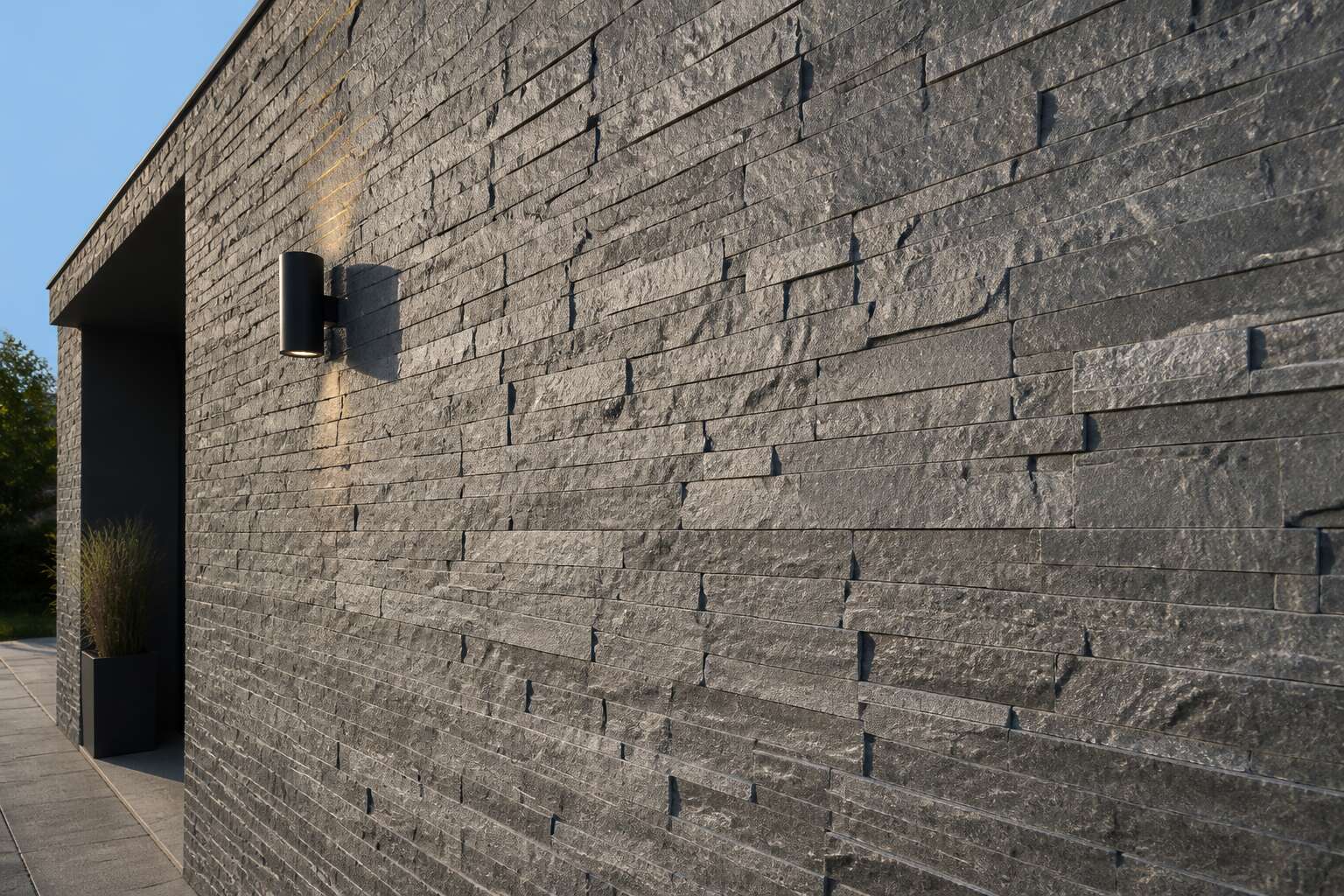
The Visual Impact of Grey Natural Stone Cladding
Modern Minimalism and Clean Lines
The grey stone cladding creates a quiet severity, a deliberate absence that speaks. Modern minimalism thrives on such restraint. Each panel stands as a monolith against the shifting light. I find the clean lines offer a discipline, a visual quiet that settles over a facade.
- rain streaks become faint veins
- sun carves angular relief
- night swallows the texture whole
This is structure made visible. Natural stone cladding grey demands nothing but attention. Its power lies in the uncompromising flatness, the refusal to soften. For those building in South Africa, this material offers a permanence that endures without noise. The effect is stark, yet never cold.
Timeless Elegance for Traditional Architecture
Grey stone has anchored South African architecture for over a century. The Cape Dutch gables and Karoo farmhouses prove it. These buildings still stand because stone does not apologize for age.
Traditional architecture demands materials that age gracefully. natural stone cladding grey delivers this. The texture shifts with weather, yet the tone remains steadfast. Stone pairs well with pitched roofs, timber beams, and clay brick. It does not compete. It supports.
Consider what this means for a heritage home:
- Stone holds thermal mass, keeping interiors cool through Highveld summers.
- The surface discourages moss growth in damp coastal regions.
- Local suppliers source most cladding from South African quarries, reducing transport costs.
I have seen old farmhouses where the stone facade looks as deliberate today as the day it was laid. That is the timeless part, and it never fails to impress me!
Complementary Colour Palettes for Exteriors
The Highveld light has a way of revealing stone colour that escapes the naked eye elsewhere. Natural stone cladding grey shifts from silver to charcoal by the hour, and this variability demands a thoughtful exterior palette. In South African suburbs, I notice homeowners pairing natural stone cladding grey with ochre plaster or deep olive woodwork. Those tones complement the rock’s mineral undertones without competing with them.
Three directions worth considering:
- Warm whites with charcoal grout for crisp definition
- Terracotta or rust accents to echo iron-rich strata
- Soft sage or muted teal for coastal gardens
The result is a facade that feels deliberate rather than decorated. Stone provides a stable base, and colour offers subtle contrast. This approach suits both city plots and open farmland, and it reflects a growing desire for materials that connect a home to its geological context.
Texture and Light Interaction
Sunlight behaves differently on natural stone cladding grey than on painted walls. The rough surface catches light at unpredictable angles, creating pockets of shadow that deepen as the afternoon stretches on. I have watched a single facade shift from pale silver to deep graphite over the course of a few hours, and that constant movement keeps the home feeling alive.
The texture changes perception more than colour itself. In the Johannesburg suburbs, where the highveld sun is unrelenting, the stone’s clefts and undulations break up glare. This makes the cladding comfortable to look at, even at noon.
Beyond aesthetics, this interaction serves a practical role. It hides the subtle imperfections of handmade materials. It also gives the building a sense of permanence that flat render cannot replicate. The light brings out the geological story embedded in the stone.
This is a viable option for coastal homes too. In Cape Town, the lower sun angle in winter produces a warmer glow on the stone. The same material reads completely differently against the Atlantic light than it does inland.
– The depth of shadow varies with the angle of the sun.
– Stormy skies flatten the stone’s texture.
– Clear mornings bring out silver flecks in the aggregate.
That variability is the true value of choosing this material over a smooth, uniform surface. It never looks the same twice, which means the house develops a character of its own.
Key Benefits Beyond Aesthetics
Durability and Weather Resistance
The South African sun is a relentless architect of decay, testing every material it touches with abrasive UV and thermal extremes. In this climate, the quiet fortitude of natural stone cladding grey becomes its most compelling attribute, a defence against a landscape that proudly breaks lesser things. This is where its true cost effectiveness over a thirty year cycle emerges, not through appearance, but through an almost stubborn refusal to yield.
A wall wrapped in this material becomes a passive partner in thermal regulation. The inherent density of the stone absorbs heat during the day and releases it slowly as the evening cools, a mechanism that measurably reduces the workload on air conditioning systems. Yet, it is the material’s resistance to the elements that truly elevates its utility:
– Withstands intense solar radiation without fading or chalking
– Unaffected by the corrosive salt spray of coastal regions like the Western Cape
– Impervious to the thermal shock of sudden, heavy rain after a hot day
– Provides a barrier against the abrasive impact of wind blown dust and sand
Furthermore, this resilience translates directly to a profound reduction in maintenance labour. Unlike painted or rendered surfaces that demand constant inspection for cracking, blistering, or peeling, a properly installed facade of this stone requires little more than an occasional rinse. The stone manages its own hydration, allowing moisture to escape through its micro porous structure, which mitigates the risk of efflorescence and structural damp. Ultimately, this is a material that answers the environmental question with quiet permanence.
Thermal Insulation and Energy Efficiency
In a country where electricity tariffs climb faster than summer temperatures, the thermal mass of natural stone cladding grey offers a measurable advantage. I have watched homes in Gauteng stay cooler through January afternoons because the stone absorbs heat before it reaches the inner wall.
- Absorbs solar gain during daylight hours
- Releases stored warmth after sunset, reducing night time heating needs
- Lowers peak cooling loads, easing strain on air conditioners
That same density works through winter nights. The stone stores heat from the day and returns it slowly, which means a smaller geyser or a shorter heating cycle. For a Cape Town home facing the south wind, this effect can trim monthly energy use noticeably. Natural stone cladding grey regulates indoor temperature through its physical properties, not through added membranes or coatings.
Low Maintenance Requirements
I have seen too many Cape Town gardens end up as storage sheds for paint tins and scrapers. Natural stone cladding grey removes that entire category of chores. Once fixed to the wall, the surface asks for almost nothing! No sealing, no staining, no seasonal touch ups.
The whole maintenance routine fits on a small card:
- Rinse with a garden hose when dust builds up
- Scrub stubborn marks with a soft brush and mild soap
- Check the joint fillers after a heavy storm
Rain handles the rest. In Johannesburg, the dry air keeps moss and algae off the stone. In Durban, the humid east wind washes the facade with every shower. Grey shades can hide a surprising amount of casual dirt, so the house looks deliberate, not neglected.
Eco-Friendly and Sustainable Choice
Concrete production alone contributes roughly 8% of global carbon emissions. Natural stone cladding grey takes a simpler route. It skips the kilns, the chemical binders, and the polymer coatings. The stone comes straight from the earth, cut into slabs, and fixed to your wall. That is the whole supply chain.
Quarries in the Cape and the Karoo supply much of the local market, which shortens transport distances. The material itself is inert, so it never offgasses harmful compounds. It also breaks down naturally at the end of its life, or gets repurposed as aggregate. Sustainability without a single recycling lecture. For a facade that lasts decades, natural stone cladding grey represents a low footprint choice.
- No cement-heavy composite layers
- No plastic mesh backing
- No factory-fabricated veneers
The product uses what nature already made, which is more than most building materials can claim.
Fire Resistance and Safety
According to fire safety data, structural fires can reach 800°C in the first few minutes. Natural stone cladding grey remains unaffected because stone is noncombustible. It does not ignite, does not melt, and does not emit harmful gases when exposed to extreme heat.
- Zero flame spread contribution
- No toxic smoke production
- Protection for load bearing walls
In South Africa, where seasonal fires threaten both urban and rural structures, this cladding acts as a dependable barrier. The stone’s thermal mass also slows heat transfer, keeping interior temperatures lower during a fire. That is not a marketing claim, it is a physical characteristic of the material itself!
Popular Types and Finishes of Grey Stone
Granite – Strength and Granularity
Moving from the aesthetic considerations, the physical character of the stone itself demands attention. Grey granite is not a monolith. Its strength and granularity dictate its performance and appearance. Each block from the quarry carries a unique fingerprint of mineral composition, which directly influences how it reacts to the elements and how it reads from a distance.
When you specify a darker, fine-grained stone, you are selecting a dense material. This density offers a high resistance to abrasion and a more uniform colour field. Conversely, a coarse-grained grey granite offers a shimmering, crystalline surface.
Consider these popular choices for your project:
– Lunar Grey: A fine to medium grain with a consistent, even colour, ideal for large format panels.
– Blue Pearl: A medium to coarse grain with a distinct metallic sheen from its feldspar crystals.
– Charcoal Black: A very fine grain, almost opaque, providing a deep, dramatic facade.
The finish applied to these stones alters their tactile quality. A polished finish reflects light and deepens the colour. A honed finish offers a flat, matte appearance, which can feel more contemporary and often minimises the visibility of natural veining. However, strength is not uniform.
Flamed finishes on coarse granites can increase slip resistance but may lighten the surface colour. Understanding this interplay is critical. A structural cladding panel demands a specific thickness. A veneer allows for more flexibility. The granularity affects the tensile strength of the panel, especially on large, unsupported spans. You must match the stone’s physical properties to the engineering requirements of the wall system. This is not a decorative choice; it is a structural decision.
Limestone – Softness and Sophistication
Limestone accounts for nearly 15% of all sedimentary rock on Earth, yet its use in cladding remains a mark of quiet luxury. I find it brings a softer silhouette to a facade, one that mellows over time without shouting. For natural stone cladding grey, limestone offers muted tones, from pale silver to warm dove grey.
Popular types include:
- Portoro Grey: a dark base with subtle white veining, best for feature walls.
- Jura Grey: a textured, fossiliferous limestone that adds depth to large surfaces.
- Moleanos: a compact, beige grey limestone that handles high-traffic areas well.
Finishes matter. A brushed finish exposes the stone’s natural grain while keeping slip resistance. A sandblasted finish creates a gentle, matte texture ideal for exterior panels. Honed surfaces feel silky to the touch, making interiors more refined. This natural stone cladding grey performs best when sealed, but that small effort pays off with timeless, understated elegance.
Sandstone – Warm Grey Tones
Sandstone is sediment given narrative, each layer a compressed chapter of ancient deserts and shifting shorelines. In South Africa, where these geological stories are etched into our landscapes, sandstone cladding grey offers a warmth that granite and limestone do not. The material holds light, absorbing the golden hour and releasing it slowly across a facade, creating a textured patina of quiet history.
The range of grey sandstone presents most prominently as these types:
– Raw Grey Sandstone: Unfussed with heavy veining, this is a utilitarian choice with a natural, cleft surface that speaks to the landscape directly.
– Autumn Grey Sandstone: A blend where grey and brown undertones merge, adding a gentle, earthy heat to the cladding.
– Classic Grey Sandstone: A consistent, even toned grey that provides an architectural, disciplined look, perfect for sharp lines.
The finish dictates the interaction. A sandblasted finish on natural stone cladding grey creates a fine, granular texture that softens the sunlight and reduces glare. Conversely, a honed finish leaves the surface silky and dense, the colour deepening in a way that feels almost liquid. For this material, the dressing matters. Sandstone is porous; it remembers water. A proper sealant becomes a pact between you and the mineral, preserving the warm grey tones against the erosive force of our Highveld storms. The result is a surface that feels older than the building, yet entirely of its time.
Slate – Layered Elegance
Slate does not borrow its character from the sun or the rain. It carries its own narrative, hewn from ancient seabeds and compressed by time. Where sandstone offers warmth, grey stone slate offers structure. It is the quietest form of confidence in the cladding world.
Each rift and cleft in the slate surface is a record of geological pressure, and a good supplier selects for colour consistency and cleavage quality. When you choose natural stone cladding grey in slate, you are choosing a material that is born for the South African climate. It takes the Highveld sun without fading and shrugs off winter frost without spalling.
- Riven finish: A naturally split surface that exposes the stone’s crystalline character, ideal for exterior feature walls that want to feel grounded.
- Sawn finish: A smoother, more uniform texture that gives a contemporary edge while retaining the slate’s organic depth.
- Brushed finish: A textured surface that softens the tonal variation and provides a tactile experience for entryways and boundary walls.
The layered nature of slate is its defining feature. Unlike granite’s uniformity or sandstone’s sedimentary warmth, slate breaks into thin, durable sheets that catch light at angles, creating a play of shadow and depth across a facade. This layered elegance is not decorative; it is a physical property of the metamorphic process.
In a landscape like ours, where buildings often compete with the raw beauty of the veld, slate does not compete. It belongs. The grey tones absorb the surrounding earth, letting the architecture sit within the terrain rather than atop it. When you walk past a home clad in grey slate, the surface seems to hold the memory of the mountain it came from.
Honed vs. Brushed Finishes
For natural stone cladding grey, the finish changes how the same stone reads under South African light. Honed surfaces are ground to a matte, low-sheen plane. Joints read cleanly and colour shifts stay subdued. I specify honed grey stone when a facade needs restraint and precise geometry.
Brushed surfaces are abraded with wire brushes, leaving fine directional grooves. The stone gains texture without losing its mineral character. Shadows gather differently across a brushed wall, and the surface responds to touch at entryways and boundary walls. Brushed finishes soften the visual uniformity of grey stone cladding.
Tumbled and Split-Face Textures
Tumbled grey stone arrives with its corners already worn, as if the wall has stood through a century of Highveld storms. The surface is softened, almost powdery under the palm, and the colour deepens in the shadows of a veranda. Split-face, however, is a deliberate rupture. The stone is fractured to expose raw planes, jagged and electric, each break throwing a distinct line of light across the facade.
These two textures turn natural stone cladding grey into a dialogue between age and force. Tumbled suits quiet boundary walls and garden seating, while split-face claims the entrance with unapologetic presence.
- Tumbled: rounded edges, low reflectivity, a softened patina
- Split-face: sharp relief, deep shadow lines, pronounced mineral depth
In South African light, both finishes perform differently by the hour, yet neither demands attention. They simply exist, stubborn and patient, like the rock they came from.
Planning and Installation Essentials
Surface Preparation and Substrate Requirements
The lifespan of your natural stone cladding grey hinges on what you cannot see. In South Africa’s climate, substrate preparation is the difference between a facade that endures and one that delaminates. The surface must be clean, dry, and structurally sound. Remove all dust, oil, and laitance. For concrete or masonry, apply a breathable primer to enhance adhesion.
Check the substrate beneath the cladding for planarity. Deviations beyond 5mm over a 2m straightedge require correction. Use a screed or level to achieve true verticality. I have seen instalment teams rush this stage, resulting in cracked panels and uneven joints.
- Test moisture content below 15% for concrete substrates
- Confirm substrate temperature between 10°C and 30°C
- Repair any hairline cracks before installation
Only then will the stone hold firm.
Adhesive and Fastening Systems
Adhesive selection for natural stone cladding grey is where installers prove themselves. The wrong glue will betray you within a season. In South Africa, heat cycles and coastal humidity punish weak bonds. Use a polymer-modified adhesive rated for stone. Cementitious products with added polymers handle the movement. Mechanical fixings provide backup. They catch the stone when adhesive fatigues.
Consider the stone’s weight and porosity. Heavy granite cladding demands stainless steel anchors. Lighter slate tolerates a simpler system. Always test adhesion on a sample area first. Trust me, this step saves sleepless nights.
Here is the non-negotiable checklist:
- Confirm the adhesive’s open time matches your installation pace.
- Use a notched trowel for consistent coverage.
- Allow for thermal movement with expansion joints.
Respect the adhesive and your natural stone cladding grey will remain steadfast for decades.
Cutting and Shaping Techniques
Nothing humbles a homeowner faster than running short of natural stone cladding grey with three square metres of wall still bare. Measure twice, order ten percent extra, and weep less. That surplus doubles as practice material.
Your cutting kit needs exactly four things:
– A wet saw with a diamond blade.
– An angle grinder for tight corners.
– A respirator for your lungs.
– A pencil that refuses to vanish.
An angle grinder creates dust and slurry in abundance. The wet saw glides through stone. Either way, mark every cut in pencil and dry fit each piece before any adhesive gets involved. Stone does not forgive hesitancy.
Plan the layout on the ground first. Trust me, shift pieces around until the natural stone cladding grey arranges itself. This is the unglamorous mathematics behind good walls.
Waterproofing and Drainage Considerations
Water damages walls slowly but surely, and natural stone cladding grey offers no exception. In South Africa, where afternoon thunderstorms arrive without apology, a proper waterproofing membrane behind the cladding is non-negotiable. I have seen beautiful installations fail within two seasons because the installer skipped the vapour barrier. The membrane must run continuously from the base to the top edge, overlapping at joints by at least 150 millimetres.
Drainage is the twin of waterproofing. Without a path for moisture to escape, the membrane simply holds water against the substrate. A drainage mat or a 10 millimetre air gap creates that path. For vertical surfaces, install weep holes at the base every 600 millimetres. These small openings allow trapped condensation to exit, preventing efflorescence and freeze damage. The ground below should slope away from the wall, carrying runoff clear of the foundation.
- Use a dimpled drainage membrane for cavity walls.
- Seal all penetrations with butyl tape, not silicone.
- Terminate the membrane above the DPC line.
For natural stone cladding grey, the hidden work determines longevity. A wall that breathes out moisture lasts decades; one that traps it crumbles from within. Plan the drainage before the first panel goes up, and you will never hear that telltale damp smell after a good rain.
Cost, Maintenance, and Longevity
Price Ranges and Influencing Factors
The cost of natural stone cladding grey often makes homeowners pause. In South Africa, prices range from R450 to R1,200 per square metre, depending on several variables.
- Stone type and quarry distance
- Thickness and panel size
- Finish and edge detailing
Maintenance stays minimal. A breathable sealer applied every five years handles stains and weathering. Longevity is impressive, with many installations exceeding half a century. I have seen grey cladding on Cape Town homes still crisp after forty years. That durability justifies the initial outlay. This stone offers permanence. The price reflects decades of reliable performance.
Cleaning and Sealing Best Practices
Natural stone cladding grey demands a realistic budget. The initial outlay exceeds cheaper alternatives, but proper care protects that investment. Cleaning returns the stone to its original character without erasing its patina.
Use soft brushes with pH-neutral soap for routine washing. Salt residue along coastal regions needs a gentle rinse that mimics rainwater. Harsh chemicals strip the surface and open pores to moisture.
Sealing is the discipline that keeps this stone performing for decades.
- Seal after installation once the mortar has cured.
- Reapply sealer when water stops beading on the surface, often around five years.
- Test each batch of sealer on an offcut for colour change.
Inspect the joints annually and repair any cracks before winter rains penetrate the substrate. I have seen neglected cladding fail within a decade.
Repair and Replacement Options
The initial cost of natural stone cladding grey in South Africa often triggers hesitation. That reaction ignores the longer arithmetic. A cheaper façade may demand replacement within fifteen years, while stone endures. This is where maintenance becomes a conversation about character, not just cleaning.
Daily care remains simple. A soft brush and pH-neutral soap handle most grime. Coastal homes require vigilance though. Salt residue can creep into the substrate if ignored.
Repair and replacement options depend on installation. Panel systems allow swapping individual pieces. Adhered systems require a more invasive process.
- Inspect anchors annually after extreme weather.
- Keep spare offcuts from installation for colour-matched repairs.
- Address cracked joints early before moisture enters the assembly.
Spalling signals deeper failure. Remove the affected section and fix the substrate cause first, otherwise the repair fails again. Natural stone cladding grey rewards patience, but it punishes neglect.
Long-Term Value and Property Resale
Ask an estate agent in Cape Town or Johannesburg which exterior finish justifies its price at resale. In my experience, the answer frequently lands on natural stone cladding grey. Stone communicates permanence, and buyers transfer that confidence into their offer price.
The true cost appears across thirty years. A cheaper façade cracks and demands replacement inside fifteen. Natural stone cladding grey, correctly installed, survives two property owners and still commands attention. Maintenance weighs little: one annual inspection, sealed joints, a seasonal wash. Those hours preserve both the envelope and the valuation.
- Retain supplier records and batch numbers.
- Treat spalling at the base cause, not the surface.
- Refresh sealants every two years.
When sale documents are compiled, the inspection report confirms the stone’s condition. That report separates negotiating a price from receiving one.
0 Comments